
A Massacre without Killers?
Tulsa and the concept of “résistancialisme.”

So many heroes. They hid blacks in their basements, in pickle vats, in servants quarters, in churches. White Tulsans hid their counterparts in walk-in refrigerators, in the woods behind their houses. There are so many accounts of white people hiding black people that you might be mistaken for thinking that the city was holding a massive game of hide-and go-seek on June 1, 1921.
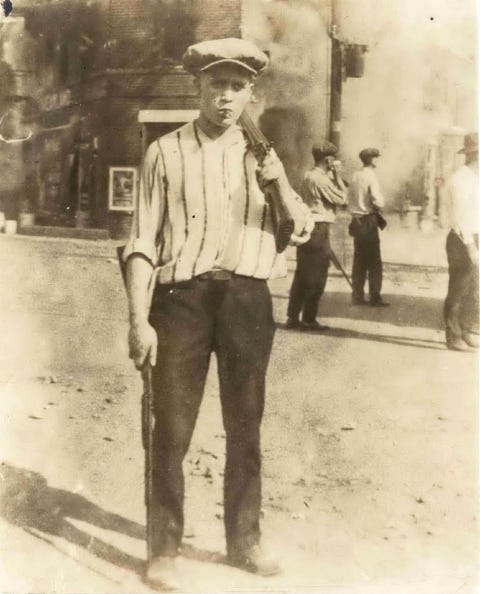
I’ve listened to dozens of oral histories, read testimonies and news reports from the perspective of white witnesses, and the scenes of terror are oddly devoid of names. The victims have names, they have stories: A.C. Jackson, A.J. Smitherman, Mary Jones Parrish. Some were killed in cold blood, others managed to flee with nothing but the shirts on their backs. There are books and documentaries to tell these stories—all as it should be.
But what about the perpetrators? Who were they?
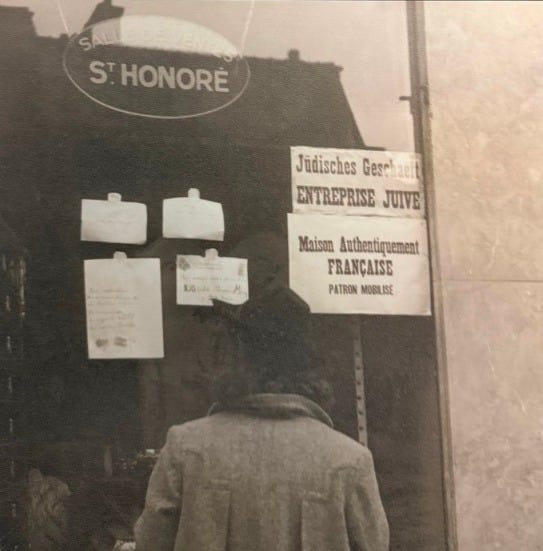
I just got back from Paris where there’s a strong attachment to the myth of the Résistance. There are plaques to the heroic fighters who resisted Nazi occupation, but less awareness about the reality, which is that most people did not resist. They watched in silence or actively helped Nazis deport 75,000 French Jewish citizens to concentration camps.
Ordinary French citizens allowed Nazis to pillage Jewish houses, take furniture and art, and install it in their own homes. The hard truth is that many Parisians actually benefited from Nazi occupation. This story is told in painful detail at the Memorial of the Shoah in Paris.
It often comes as a shock white Tulsans to learn that Greenwood once extended well into what is today the Arts District. There are oral histories of black servants finding jewelry looted from Greenwood in the houses of well-to-do white Tulsans. But this is oral history. There was no trial, no commission to restore property to those who were victimized.
In France, the myth of widespread Résistance among the population has been thoroughly debunked. In fact, it has its own term: “résistancialisme.” After the War, Charles de Gaulle need to reassure citizens of their righteousness. France was ready for its collective memory of the Occupation to be gerrymandered so that the pockets of résistance became the mainstream.
Now, what happened in Tulsa in 1921 was on a completely different scale from Nazi occupation of France, where national complicity led to 75,000 deaths. Tulsa was shamed in the national press for what happened in 1921, and whites engaged in their own version of “résistancialisme” on a local scale.
Hence, the hiding of black people in basements. White Tulsans’ collective memory oriented itself around protecting its innocence and deflecting responsibility for the crimes. That continues to this day, and I want no part of it. We need to know the unvarnished truth, as John Hope Franklin used to say.
All of this leads me to a man named George H. Blaine, a friend of Russell Cobb I, former Police and Fire Commissioner of Tulsa, and my great-grandfather.
With a chiseled jaw and piercing blue eyes, Blaine looked every bit the dynamo he was on the job. Blaine was the sort of person who ran toward trouble, and in his early years as a cop, he often arrived on a motorcycle while in plainclothes. There is some anecdotal evidence that he was one of the hooded vigilantes from the Knights of Liberty involved in the kidnapping and torture session of the Tulsa Outrage, and the event’s date--1917--corresponds with his entry on the police force at the age of 21.
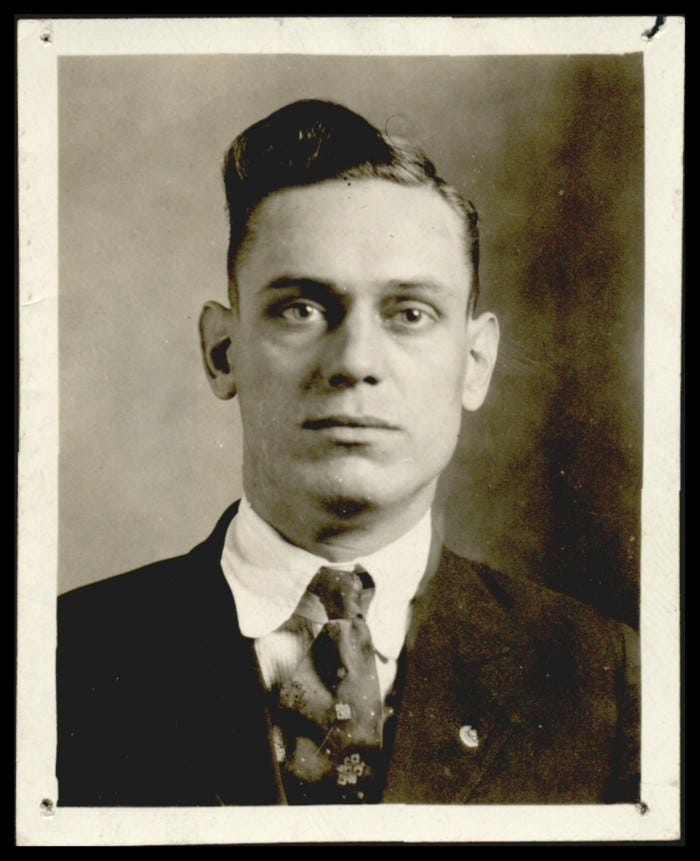
He was only in his mid-20s when he was made a Captain in 1920. Tulsa had developed a reputation as a place where anything could be had for the right price: booze, prostitution, and gambling flourished even in the city’s finest establishments like the Hotel Tulsa. Blaine took it all on.
Blaine took risks that got noticed by the press. He got into high speed car chases that turned into running gun battles. He destroyed liquor operations by smashing beer bottles and chopping up stills. In July, 1920, his daring almost cost him his life. He pursued a bootlegger down Admiral Boulevard, and found 30 gallons of corn whiskey in his car. When he went to arrest the bootlegger, his runner--the man in charge of delivering the goods to customers--fired on Blaine, striking a $20 gold piece on his trouser pocket. Another bullet hit Blaine’s coat, barely missing him. Blaine pulled out his revolver and hit the runner four times in the chest.
After this incident, Blaine became something of a celebrity cop, and the Tulsa Tribune sent him a $25 payment as part of an award for bravery for the battle with the bootleggers. During the Great Depression, Blaine probably met Russell Cobb in his espionage work for oil companies. Blaine was at the Mid-Continent Refinery Company when the west Tulsa strike broke out, and helped coordinate police and company counter-strike measures. When he later ran for Tulsa County Sheriff, west Tulsans bitterly opposed him, associating him with the dirty tricks of the strike breakers. Russ, on the other hand, thought he was just the kind dynamo Tulsa needed. Blaine was Russ’s first choice for Police Chief in 1940.
“I like this bird, Blaine,” Russ said. “He looks a lot like Lincoln and talks simple and straight. He would be my choice for chief except a lot of folks would say the Mid-Continent folks named the chief. I don’t want anyone to think any company or group is running me.”
It was Blaine’s activities in 1921, however, that most caught my attention. Without a doubt, Blaine was a major protagonist of the events of May 31 and June 1, 1921. He was on the frontlines of the initial skirmish between armed blacks and a white mob at the courthouse, and was later in an airplane surveying the large-scale battle. Given Russ’s friendship and political support for Blaine in the following years, I wanted to know more about Blaine’s role. The truth was maddeningly difficult to ascertain but the preponderance of evidence suggested a man who, at the very least, tolerated a collective barbarity to take hold.
During a grand jury testimony following the tragedy, Blaine gave an hour-long description of his experience. He stated that he was a police Captain under the orders of Chief Gustafson, and their first duty was to make sure the young black man accused of assault--Dick Rowland--was not taken from the jail and lynched on May 31. Blaine and Gustafson confronted a white mob that wanted to kidnap Rowland, but police officers held the mob back.
As a carload of armed black men arrived, Captain Blaine flew into action. He jumped on the running board of one of the cars and started arguing with the men, ordering them to go back to Greenwood. He wrestled one man and “we both fell off the car, and I finally got the other fellow’s gun.”
Blaine estimated there were some 60 armed black men, but the white mob had grown to about two thousand people whose attention was now on the Black men, not on the suspect in custody. A white man from the crowd tried to wrestle a gun away from a black man and a shot went off, setting off a confusing battle that left several people--white and black--dead in downtown Tulsa. That part of the story has been well-documented and recounted many times.
What is still unclear is what Captain Blaine did next, as whites were organizing for a full-scale armed invasion of Greenwood in the early morning of June 1. We know that there was widespread looting in downtown stores, as young white men looked for weapons. To hear Blaine tell it, he tried to stop the looting and urged calm, pushing whites away from a zone where black snipers were shooting at invaders. Gustafson believed it would be “practically suicide” to get more involved, but Blaine was right there as the looting took place.
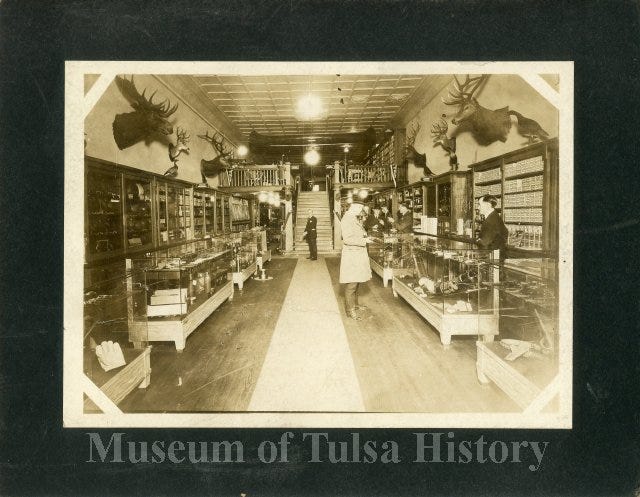
At about 11:00pm on May 31, Blaine spotted 300 white men trying to break into the J. W. Magee Sporting Goods store. He managed to stop them, but then a crowd discovered the back door. “They rushed me,” Blaine claimed. He was pushed through the door and into the mayhem. “I did my best to get the men out of the store and failing that, asked them to do as little damage as possible.”
As the invasion commenced, Blaine raced to the airport and got a seat in an airplane that circled the area, looking for a possible counter-offensive by black forces, perhaps from a neighboring town. Seeing nothing, he returned to Tulsa until martial law was declared when the National Guard arrived to stop the destruction. A reporter for the Tulsa World noted that an attorney asked Blaine if he set fire to any buildings, “did any looting or murdering in the negro district.”
“[Blaine] laughed and shook his head.”
Some secondary sources have portrayed George H. Blaine as an active participant in the violence, first by deputizing armed looters and then encouraging them to go on the rampage. Scott Ellsworth, in Death in a Promised Land, states that, contrary to Blaine’s testimony, he did not get pushed into Magee’s hardware store, but rather organizing the looting. The owner of Magee’s believed Blaine was “the one who broke into his store and dealt out the guns.”
Ellsworth also confirms that Blaine was in one of the airplanes flying around Greenwood, although the record is still unclear whether his airplane dropped incendiary devices on the neighborhood. We also know that the deputization of drunk and disorderly white men was a major contributor to the violence, and it is possible that Captain Blaine, along with another friend of Russ’s–Commissioner Adkison–deputized many of these men, who then believed they had free range to loot, pillage, and even kill Black people.
Even a charitable view of Blaine and Adkison’s actions during the Massacre would have to acknowledge that these two police officials did nothing to stop the atrocities of deputized whites once the invasion was underway in the early morning hours of June 1. Rumors about Blaine’s involvement circled around the city for years, and came into public view after Russ resigned his position as Police Commissioner in 1942 to rejoin the military. Blaine had butted heads with longtime police officer John Smitherman, considered by many to be the city’s best detective. Smitherman, a Black man who once had his ear cut off by Klansmen, was not easily intimidated, but when Blaine fired him, Smitherman struck back with a media operation.
Smitherman collected stories about Blaine’s activities on those two fateful days in spring 1921 and then paid a journalist named O.B. Graham to write them up in his newspaper, The Appeal. Smitherman, apparently, wanted the statements about Blaine’s role posted on handbills. I cannot find any extant copies of The Appeal, but the Tulsa Tribune summarized the piece when Blaine sued Smitherman for libel, stemming from the article (Blaine’s lawsuit went nowhere, and may have been an attempt to discredit Smitherman). According to this missing article, witnesses placed Blaine squarely among the looters and arsonists in the morning of June 1, 1921. Blaine, the piece claimed, was the Tulsa Police Captain “active in the burning of homes in the Negro district.”
A bricklayer named Laurel Buck, testified that when the violence broke out, he went to police officials to be deputized. He did not receive a deputy’s star but someone in the police department told him to “get a gun, and get busy and try to get a n*****.”
Was it Blaine or Adkison who gave Buck those instructions? Even if it was someone else in the Tulsa Police Department, they would have to answer to the higher brass, and that higher brass would later be retained and promoted by Russell Cobb two decades later. What did Russ know about his friends’ actions on those two days in 1921? If he knew how intimately they were involved, would he have changed his mind about endorsing them for higher office? He stumped for Blaine when he ran for Sheriff, and wrote a letter commending Adkison to presidential hopeful Thomas Dewey. But he also commended a number of black Tulsans for supporting Republicans as well, including his bartender/confident, John Alexander
Finally, I wondered about what my namesake did on June 1, 1921. He was in Tulsa at the time, working for Empire Oil Company from 1919 to 1921. In September of that year, he left the country to provide famine relief in the Soviet Union under the direction of Herbert Hoover. Russ—a New Yorker with deep roots back east—had fallen in love with Tulsa. He would eventually return there with his aristocratic Russian wife and have a son—Russell Cobb, Jr.
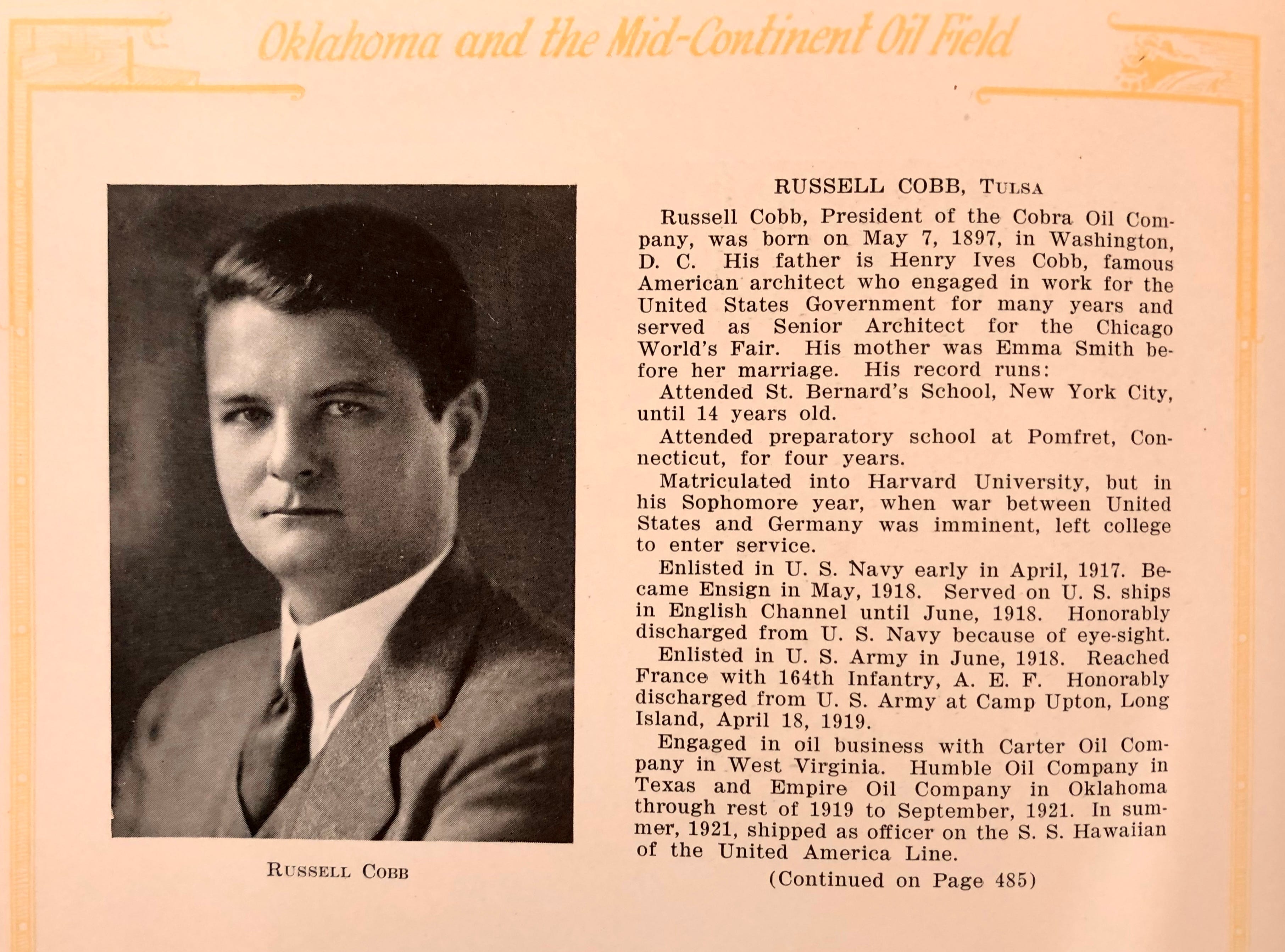
Unlike a lot of old Tulsa families, I never heard anything about my great-grandfather hiding blacks in his basement. In fact, I never heard anything about a massacre, a riot, or anything other than our own version of “résistancialisme.” The Cobbs had helped their black chauffeur/bartender become the first black mail carrier in Tulsa. So it was said. I did a little digging and found that wasn’t true. What else wasn’t true?
I asked a lot of questions but all I got was silence. Family members stopped talking to me. I was told I was writing “woke propaganda.” I was the literal devil according to one relative.
Was I being ostracized because I was getting closer to the truth or because I had disturbed the peace of the dead? I’m sure my relatives see this whole endeavor as pointless as best, dangerous at worst. I pushed on, aware that I would never know what my great-grandfather was doing in Tulsa on June 1, 1921. I would never know if his friend, George Blaine, had bombed Greenwood.
The lack of clear answers drives me to despair sometimes, but I take some bit of solace from the words of Rabbi Tarfon:
“You are not obligated to complete the work, but neither are you free to abandon it."
Great piece, Russ. I agree that the identities and stories of whites who participated in the massacre are the big missing part of this history. I would take some issue with your French analogy, which you focus on the experience of Jews during the war. The French resistance, whether De Gaulle’s Free French based in London and the colonies or the internal resistance, was more broadly opposed to Nazi rule and especially Vichy collaboration. It was not primarily concerned with saving France’s Jews, although that did become of greater importance from 1942 to 1944. Only decades later did France’s treatment of its Jews become a central part of how the Occupation was remembered and judged.
The only reason I found out about June 1 is because I found a book about it in our home. I tried to ask questions and I was pretty much shut down.